
In his opening remarks at the virtual summit of the Shanghai Cooperation Organisation (SCO), Modi also said that some countries use cross-border terrorism as an instrument of their policy and the grouping must not hesitate to criticise them.

In spite of irritants and hiccups in the relationship, a few deliverables are expected of the prime minister's visit to China, says Rup Narayan Das.
'By not even acknowledging China's occupation of Indian territory Modi signalled to Beijing that he was not prepared to used forceful means to vacate the Chinese occupation, and that his government was reconciled to this loss of territory and accepted the fait accompli engineered by the PLA.'

Leading IT analyst Gartner on Monday said organisations operating in "constrained environments" in emerging nations such as India and China are innovating at a faster rate than ever before.

The border personal meeting was marked by saluting the national flags by both the delegations members.

The President was replying to a question on whether Laos and Cambodia leaned more towards China than India. Patil felt that the full potential of trade and commerce between India and the two ASEAN countries had still not been exploited and hoped her visit would prove effective in enhancing it.

'If an 'informal meeting' with Xi Jinping materialises before the SCO summit in June, that itself could be regarded as a significant breakthrough in India-China relations,' says Ambassador M K Bhadrakumar.
This round of negotiations takes place three months after the last meeting of the special representatives in New Delhi indicating speeding up of efforts to resolve the boundary dispute.
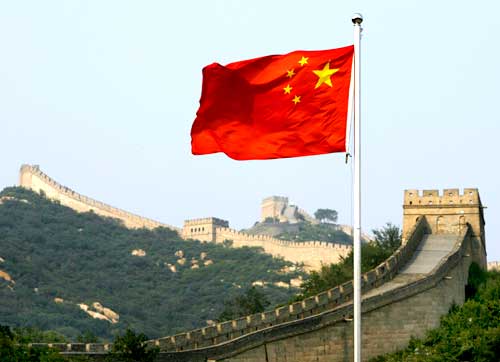
China has lodged a protest with India for hosting a Taiwanese parliamentary delegation and asked it to deal "prudently" with Taiwan-related matters but New Delhi on Wednesday dismissed the issue saying no "political meanings" should be read into such trips.
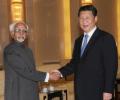
Vice President Hamid Ansari on Monday held talks with Chinese President Xi Jinping and conveyed the new Indian government's interest in furthering bilateral ties, even as he flagged off India's concerns over border related issues during his parleys with the top leadership in Beijing.

The announcement was a surprise as the new administration to be headed by the new Premier is scheduled to take over during the annual Parliament session slated to be held from March 5 next year.
China's national legislature -- the National People's Congress (NPC) -- on October 23 adopted the new law on the protection and exploitation of the land border areas which drew sharp reaction from India as it was passed amid the protracted military standoff between the two sides in eastern Ladakh region.
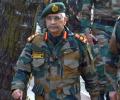
'India will keep trying to avoid conflict.' 'This is the moment when we draw a line in the sand.'

'Wang Yi said the border issue is important and we should stay committed to peacefully addressing it through consultation and coordination.'
Indian and Chinese naval vessels conduct bilateral exercises

President Xi Jinping's visit may put relations between India and China on a new trajectory
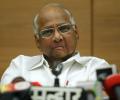
NCP president Sharad Pawar on Friday said there should be a presentation by the government on what is happening on the India-China border, particularly in Ladakh, where the armies of the two countries are involved in a face-off. Pawar, who is in the national capital to attend a meeting of the Parliamentary Standing Committee on Defence, said there are other defence-related issues on the table for discussion, but he will make a request that a presentation is made on it.
If long-term investment flows and not trade flows are taken as the real yardstick for assessing the soundness and durability of the economic relations between two countries, India and China have still miles to go before they can celebrate.

The External Affairs Minister said the Wuhan informal summit was held without any agenda and without having any objective to discuss any specific issue.
India and China on Monday began talks to put in place a mechanism for management of the border between the two nations, an issue that has been an irritant in bilateral relations.

'A firm national resolve can only deter and defeat the nefarious designs of the adversary,' notes Rup Narayan Das.

Noting that a spirit of cooperation and competition prevailed between India and China, Defence Minister A K Antony on Saturday said negotiations to resolve the disputes between the two will take their own time and he does not expect any "miracles".
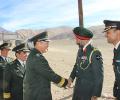
Amidst reports of Chinese incursions, the Peoples Liberation Army and the Indian Army on Sunday decided to uphold treaties and agreements signed between the governments of the two sides to maintain peace and tranquility along the Line of Actual Control.
"Our relations with emerging, I would rather say emerged, centres of power in the multi-polar world like India and China will remain the priority in our foreign policy in 2008," Russian Foreign Minister Sergei Lavrov said.

"China and India are the two most egregious violators (on infanticide)," Congressman Christopher Smith said during a Congressional hearing convened by the powerful House Foreign Relations Committee on Thursday.

On Day 2 of the summit, Modi and Xi held a fresh round of one-on-one discussion at the Taj Fisherman's Cove Hotel.

We present the translation of the full speech given by Chiese Prime Minister Li Keqiang at the Indian Council of World Affairs in New Delhi on Tuesday.
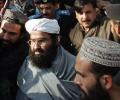
He, however, asserted that China was against terror outfits and any form of terrorism.

China's closer and enhanced relationship with Pakistan is putting considerable strain in India-China relations, says former RA&W officer Jayadeva Ranade.
India and China needed to develop mutual trust and respect to strengthen bi-lateral relations, Bharatiya Janata Party president Nitin Gadkari said in Itanagar on Thursday.
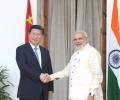
The Modi-Xi meeting assumes significance as India-China relations have followed a southward trajectory over contentious issues.

The importance of China as India's top trading partner cannot be understated.

By offering aid to China in its hour of need we will create an opening to Xi Jinping to rectify his policy towards India, argues Colonel Anil A Athale (retd).

India has told China that disengagement at all friction points is necessary to contemplate de-escalation of troops in eastern Ladakh even as the foreign ministers of the two countries agreed to establish a hotline for "timely" communication and exchange of views.

'If the Chinese were keen to mend fences with India, they would merely have to withdraw their troops in Eastern Ladakh.' 'They have not done so and they have not said that they will do so.'

'When armies start attacking with clubs and batons, then at some point this can take an escalatory spiral and spin out of control.'
As external affairs minister S M Krishna travels to Beijing on Tuesday for talks till April 8 with his counterpart, Yang Jiechi, highly placed sources in the establishment confirmed that India and China have been in talks for some time to ban Masood Azhar of the Jaish-e-Mohammed, Abdul Rehman Makki of the Jamaat-ud Dawa and Azam Cheema of the Lashkar-e-Tayiba, under the UNSC resolutions.
